SMILING JESUS by Steve Murphy
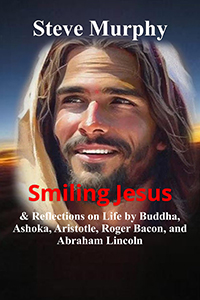
- Author:
- Steve Murphy
Man, a curious creature. Some more significant than others, while the vast majority fall in the dimness of obscurity. There are a handful, such as those that are about to be depicted that have emblazoned an impact on their personal universe that has survived long since their passing. Much time has been spent chronicling the accomplishments of the individual in these six cases that individuality has been overlooked in the process.
When one thinks of Jesus of Nazareth, for example, the concept is perceived in a three act play. Act one, the birth, is celebrated by Christians in the season of Epiphany with the Nativity re-enacted during the yuletide. Acts two and three occur during the lenten season where Jesus’ death and resurrection have been remembered as a time for sacrifice. These are considered events of high drama for all Christian religions with some, such as Catholicism making part of this process a daily occurrence in the celebration of the mass. The objective of this book is to move past these significant events and look into the persona of Jesus of Nazareth. This means going far beyond the Virgin birth, death on the cross and the eventual resurrection. It is an attempt to see how one man can even cause our calendar to reflect the time after his birth, the event was so significant. Anno Domini means the year of our Lord, or the date that Christianity began as expressed in the Gregorian Calendar, introduced by Pope Gregory XIII in 1582 (note that this date is in Gregorian terms). This calendar is used by most countries in the world to reflect day and date.
It is almost an incomprehensible notion of the mind when one ponders the human genesis. There are theories ranging from the “Big Bang Theory,” to Darwin’s Theory of Evolution. The problem has been addressed by scholars throughout the ages with more than a bit of controversy. The famous Scopes Trial where Darwinian theory actually ended up in the court room is only one example of our fascination with origin of the universe. Rather than arguing concepts, our objective is to encapsulate the conceived as one with which the reader can identify.
When one reads the Bible, especially the Old Testament, the conclusion is quickly made that our Deity is judgmental. Toe the line, or suffer the consequences! As the pages of the New Testament are perused, this approach seems to soften somewhat and God is depicted more as a loving person. Matthew 5:12 notes: “…Rejoice and be glad, for your reward in heaven is great…” Just as Bruce Barten noted, Jesus was a great leader, liked a good party and was not frail as some portraits have depicted him. Here was a man with muscles crafted from many years of helping his father as a carpenter, yet little is chronicled of those days with most of the writings concentrating on his last three years with the disciples.
There are others who have had a profound influence on humanity long since their demise. In these cases as well, the acts of the person eclipse the person. Two of the six persons examined in this book represent the duo who have most influenced Buddhism and its tenets throughout the world. Although Buddha died more than 2,500 years ago, today his philosophy is embraced by over 300 million inhabitants of this planet. Here is a religion which even surpasses Christianity in perseverance. What was the nature of Buddha as a person? Possibly the study will just raise more questions.
Second only in influence to Buddha in Buddhism, was the Indian Prince Asoka, or Ashoka as some depict him, the most influential ruler of his time. He became a convert to Buddhism and was second only to Buddha in his religious influence. What is the nature of one who converted from tyrant to piety? What curious manner of events could create such a conversion?
Two others in this sextet of individuals fall into the category of intellectual curiosity. The apex of this curiosity pyramid is Aristotle who influenced many of our academic disciplines ranging from philosophy and history to mathematics and science. His profound influence as a teacher and scholar survives the centuries. Other than the fact that Aristotle was the quintessential example of Mensa, what form of human being was he? Did he have the capacity for compassion? Did he like to joust with lions, or just sit around reading and writing all day? Based upon the writings concerning this prolific scholar, little attention is given to the make up of his personality.
The second person who fits into Aristotle’s category is Roger Bacon whom many consider as the creator of modern scientific theory. Although mathematics and astronomy may not have been his strong point, his experiments in alchemy served as a foundation for much of our approaches to science today. Bacon also ventured into the philosophical side of things, somewhat influenced by Aristotle in many of his personal pursuits. If there was ever any person in history that served as Aristotle’s clone, it was probably Roger Bacon. Why would Bacon pursue this course? What was the make up of Bacon the man that prompted his drive for accomplishment?
As a means of coming full circle Abraham Lincoln is examined to determine some of the parallels between his life and Jesus of Nazareth. Like a rough hewn log from his spartan youth to the time of his assassination, Lincoln’s life was not a series of triumphs, rather many defeats, before becoming president. Just as Jesus had moments of despair (remember the Garden of Gethsemane), Lincoln had the intensity and fortitude to overcome. What manner of man can cast off the chains of adversity, moving on to even greater triumph as a result.